Context Once the development environment is ready, the next decision is which problem to work on. An initial idea often mixes goals, features, visual preferences, and technical choices. Before implementation, turn those ideas into a clear user scenario, an initial scope, and acceptance criteria that can guide design and development.
Start with three questions: Who is it for, what problem does it solve, and what should the first version do? Then follow the user's task from beginning to end to check whether the answers are specific enough.
Produce a short, revisable definition of the user, value, complete journey, current scope, and validation plan. Adjust detail to the product.
Choose a starting point below, then define, research, scope, and review the product. Replace prompt placeholders; mark unknowns as “to discuss.”
1. Choose a Path Based on How Clear the Idea Is
Bring an outline for review, or use conversation to clarify a vague idea. Both paths lead to the same product definition.
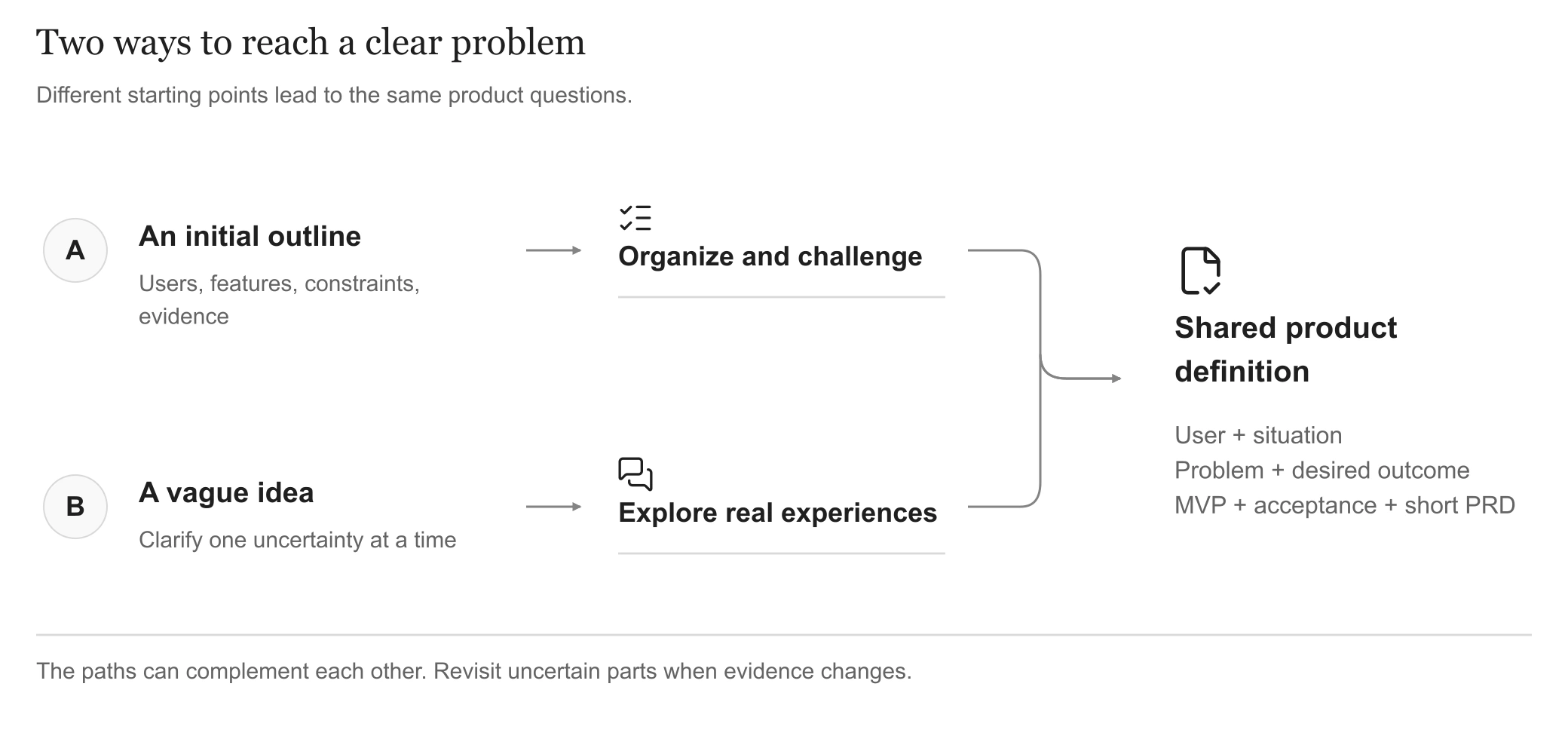
An outline and an open conversation are complementary starting points. Revisit uncertain parts as evidence changes. Open full-size diagram
Path A: Start with an Initial Outline
Give AI your work experience, requirements notes, feedback, or feature list. Examine which user task each feature serves, why it is needed, and which judgments lack evidence. Even a detailed list can leave the audience and core value open to challenge.
This prompt can start the full product definition process. Sections 2–6 explain how to assess the quality of its results.
Path B: Start with a Vague Idea
If all you can say is "I want to build a learning tool" or "I want to improve this part of my work," start with a recent difficulty, the current approach, and the change you want. Explore a few questions per turn, then compare a small number of directions once there is enough context. Keep the product form and features open for now.
A rough idea or one actual experience is enough; other fields can stay blank. Once you can provisionally describe the user, situation, difficulty, and desired outcome, prepare a one-page exploration summary and continue with Section 2.
Use either path or combine them. Return to exploration when evidence challenges the user or problem. Conversation still needs research and actual feedback; using an existing tool or postponing is also a valid outcome.
2. Define the User and Core Value
Describe a Specific Situation
"Build an AI learning tool" gives a direction, but it does not yet define the first version. "Help people learn more efficiently" also needs detail. What are they learning? When do they need help? How do they handle the task now, and which part is difficult?
Use this sentence to draft a problem statement:
For [a specific group of users], when [a situation occurs], the current approach of [how they handle the task] creates [a specific difficulty]. The product aims to help them [complete a core task], and we will examine its value through [an observable outcome].
For a knowledge practice tool, an example hypothesis could be:
Independent learners who have just read a passage want to check their understanding. Rereading offers little explicit feedback, while writing questions and checking answers by hand takes effort. The product aims to turn the passage into a practice session that helps reveal specific gaps through questions and explanations.
This description already helps with priorities. The relationship between questions and source material, answer feedback, and a learning recap deserve attention. Leaderboards, shareable graphics, and virtual presenters each need a separate explanation of how they help the core task.
Choose the First Group of Users
A product may eventually serve several groups, but the first round of validation benefits from a clear audience. Students testing themselves, teachers preparing questions, and businesses running training may all use a knowledge practice tool. Their needs for question review, saved results, and access permissions differ.
| What to clarify | Questions to ask |
|---|---|
| Target user | Whom does the first version prioritize? What is their background? |
| Situation | What triggers use? On which device and in what setting? |
| Current approach | Do they use another product, a spreadsheet, or manual work? |
| Main difficulty | Which step takes time, causes mistakes, or cannot be completed? |
| Desired outcome | What result would make this session useful to them? |
Initial answers may come from observation, work experience, conversations with users, or existing usage records. Keep unsupported answers as hypotheses for further research.
3. Combine Human Judgment with AI Research
Turn Existing Material into Research Questions
Bring together the problem statement, observations, and constraints from the first two sections. Find gaps most likely to change the direction. Narrow "research competitors" into a question that affects a decision, such as whether early users can work with pasted text or whether a business task requires an audit trail. Prioritize assumptions whose failure would change the user, core journey, or scope.
People familiar with the setting should supply its context. Data permissions, approval processes, content updates, and source traceability may all affect the choices. Record sources and missing material, and assign a next validation action to each important question.
Research Specific Questions
You can alternate between tools with web research capabilities and conversational tools. Use research to find sources and understand existing approaches; use conversation to organize material, compare options, and draft the document. Check information that affects a decision against its original source.
Useful research questions include:
- How do people already complete the task, and where does that approach fall short?
- Which value do similar products emphasize first? What happens between opening the product and obtaining a result?
- Which features directly support the core task, and which support retention, collaboration, or charging for the product?
- Which external capabilities does the idea depend on? Do data availability, interfaces, cost, or deployment conditions affect the first version?
A competitor comparison should record concrete observations, such as the first use journey, input requirements, output format, and failure handling. A checklist of product names and features still needs an explanation of what the differences mean for the intended user.
| Comparison area | What to record |
|---|---|
| Audience and task | Whom the product explicitly serves and what it helps them do first |
| Core journey | Conditions for starting and the main steps to a result |
| Output value | Whether the user receives a file, answer, report, or completed action |
| Usage limits | Supported inputs, quotas, account requirements, and observation date |
| Relevant choices | Which decisions fit your scenario and which need reconsideration |
Questions about user behavior need conversations or observation. To investigate whether early users can work with pasted text, ask people who fit the scenario to demonstrate their current approach using material from a recent task. Record where they get stuck, existing alternatives, and the effort involved. Ask about experiences that have already happened; keep statements about future willingness to use the product as hypotheses.
Distinguish Facts from Uncertainty in the Analysis
AI can help suggest explanations and approaches. Examine the basis for a convincing answer by separating three kinds of information:
- Known facts: information with a source, observation, or record you can check, such as steps you experienced while using a product.
- Interpretations: explanations drawn from those facts, such as the possibility that a prerequisite increases the effort of first use.
- Hypotheses to test: judgments that still need user conversations, a prototype, or actual use, such as willingness to pay for an outcome.
Record the source, checking date, and next validation step for important claims.
Feasible is not the same as useful. Check whether users have the task and why existing approaches fall short.
Research Alternatives and Evidence
Use this prompt to compare existing approaches. List questions that require user conversations or direct observation as follow-up validation actions. A source supports only what it actually establishes.
Use the web research capabilities prepared in the first stage. Write findings that affect scope back into the problem statement and assumption list before defining the MVP. You do not need to complete an exhaustive competitor study before making scope decisions.
4. Define the MVP Around a Complete Journey
Find the Shortest Complete Journey That Delivers Value
MVP stands for Minimum Viable Product. It delivers core value within a limited scope and helps test a defined set of assumptions. First identify what this round needs to establish, then decide how much to build.
For the knowledge practice example, test whether one complete session helps users discover gaps in their understanding.
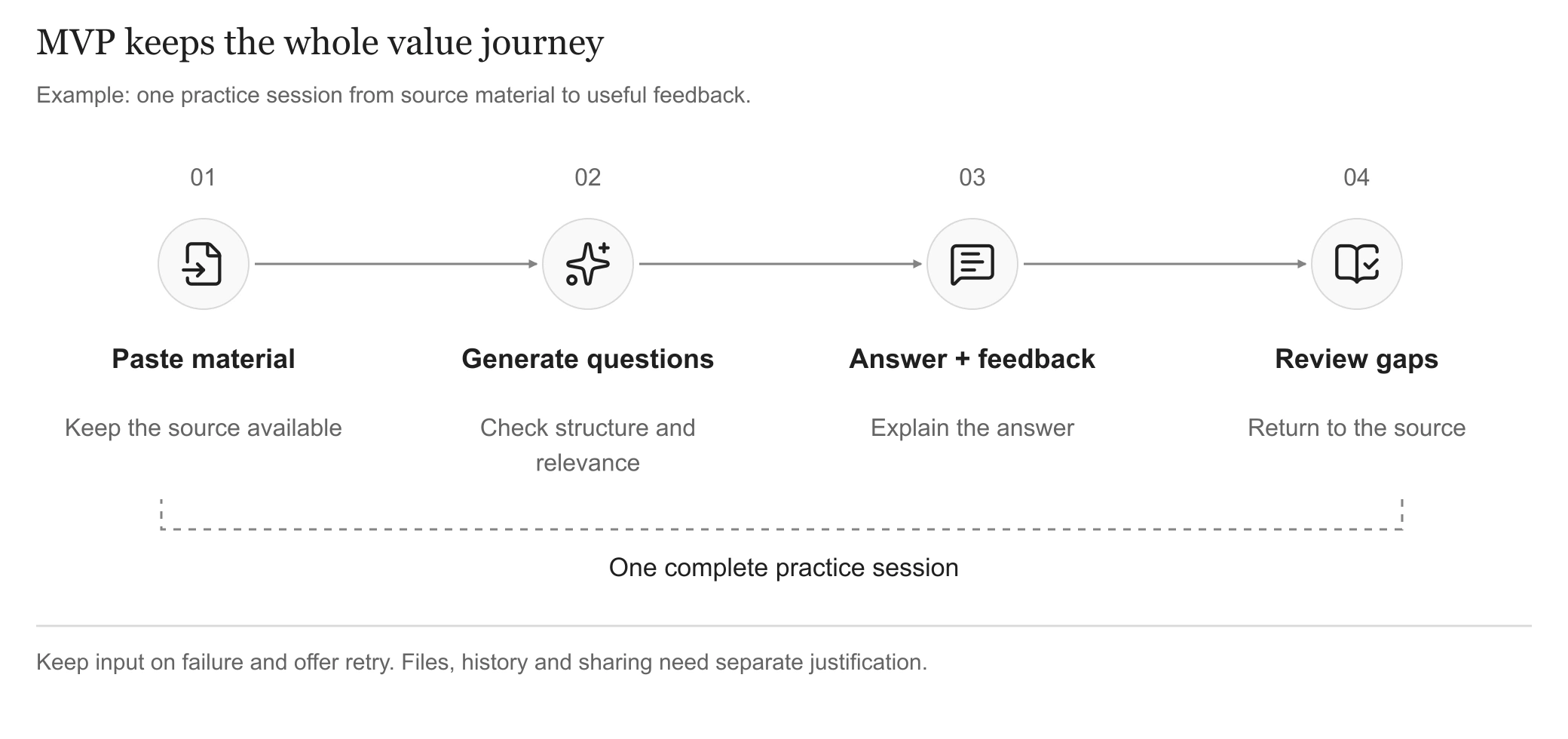
Example: a single practice session. History, richer inputs, and social features need separate justification. Open full-size diagram
A generation endpoint alone leaves the user’s task unfinished. Keep input, practice, feedback, and review in the same journey.
Start with one input type. A recap can be a results page; evaluate sharing, downloads, and history separately.
Decide What Belongs in This Version
Ask whether the core value would still hold without a feature. Also check whether it provides a necessary condition for the current round of validation.
| Decision area | Question |
|---|---|
| Core task | Can the user still complete the main task without it? |
| Validation goal | Can you still test the most important assumption without it? |
| Conditions of use | Would its absence prevent actual use? |
| Simpler alternatives | Could a simpler interface, manual step, or narrower scope work for the first round? |
History belongs in scope when reviewing across sessions is central. Training may require identities and records; a payment hypothesis needs observable purchase behavior.
Judge databases, knowledge retrieval, accounts, and payment against the task. Retrieval may be central when an existing knowledge base is the necessary source for answers. Decide its place in the MVP from that requirement.
Record Inclusions and Deferrals
A scope table should include why something is deferred and when to reconsider it. The following choices illustrate a knowledge practice tool:
| Current scope | Deferred work | When to reconsider |
|---|---|---|
| A single text passage as input | Documents, videos, and web pages | Early users need these sources and the text journey has received feedback |
| One question format with explanations | Multiple formats and generated illustrations | Different formats have a demonstrated role in the learning task |
| A recap of the current session | Sharing, report export, and historical trends | Users need to take results away or return for ongoing review |
| Individual practice | Multiplayer challenges and leaderboards | A specific shared learning scenario has emerged |
Apply the same approach elsewhere. A download tool can first test downloading from specified sources. A personal website can define what visitors need to find. An internal system can focus on one business task that can run from initiation to completion.
5. Write Requirements That Can Be Checked
Describe Behavior Beyond Feature Names
"Intelligent summaries," "a friendly interface," and "fast responses" express intentions. Add the trigger, input, output, and what happens when something goes wrong.
For each core requirement, ask when the user starts it, what the system processes, what the user receives, and how they can continue after a failure.
For example, expand "provide feedback after an answer" into:
After the user submits an answer, display the correct answer, their answer, and an explanation. The explanation should correspond to the input material. After reviewing feedback, the user can move to the next question. If generation fails, preserve the input and provide an understandable message and a way to retry.
Check the normal journey and the main exceptions: empty or unsupported input, processing, failure, duplicate submission, and whether the user needs to resume after leaving. Define the behavior for situations relevant to the current task.
Define Quality for AI Output
An AI requirement should explain how people will use the output and which errors would disrupt their task. For a knowledge practice tool, check whether questions are grounded in the input, the wording and choices are clear, and answers agree with explanations. For a summary tool, check for missing essential information, whether conclusions can be traced to a source, and how insufficient material is handled.
Prepare a small set of representative inputs covering normal, boundary, and failure cases. Describe the expected behavior before deciding whether numerical targets are useful. Set quality, waiting time, and cost targets for the actual scenario, and distinguish intended targets from measured results.
Check Functional Completion and User Value Separately
Functional completion and user value need different evidence. A successful demonstration does not replace observation of real use.
| Compare | Functional acceptance | Value validation |
|---|---|---|
| Core question | Does the system behave as defined? | Does it help the person solve a real problem? |
| Practice example | Complete a session; preserve input on failure; show a recap of this session. | Discover gaps; actually return with new material; understand why people continue or stop. |
| Evidence | Representative examples, edge cases and failure paths checked against expected behavior. | Observe real tasks, useful outcomes and repeat use; record behavior separately from stated interest. |
| What it establishes | Delivery meets the agreement; this alone does not prove product value. | Evidence for continuing, adjusting or stopping, within the limits of the trial. |
Describe a specific experiment: who participates, which actual task they use, what behavior to observe, when to review the results, and what would change the decision. Choose participant counts and thresholds for the setting before the trial. Record task completion, discovered problems, and repeat use separately from stated interest. The example in Section 6 shows this format.
6. Assemble the Product Definition in a Short PRD
A PRD is a Product Requirements Document. Bring the problem, evidence, scope, and acceptance criteria into one current version, recording decisions and open questions. The initial document can be brief. Use this template for a new product or an iteration of an existing one.
For an existing product, add its current behavior, the proposed change, and capabilities that must be preserved. This helps reveal whether the new requirement affects an established journey.
Store the requirements in project Markdown or a document tool suited to the collaboration. Maintain one clear current version, with links or attachments for research and longer records, so that different documents do not describe conflicting scopes.
Example: A Short PRD for a Knowledge Practice Tool
The following draft brings together the earlier examples. This is a hypothetical project used to illustrate the format; it has no actual user validation yet. Input limits, participant counts, and decision thresholds are illustrative choices. Adjust them for the setting and agree on them before the trial.
Background and problem: The first users are independent learners who have just read a passage and want to check their understanding. They may currently reread it or write their own questions, but struggle to identify gaps. This is a product hypothesis to investigate through interviews; no interview records or competitor testing evidence are available yet.
Current goal and hypothesis: Help a user complete a practice session grounded in the passage and identify one point to revisit. The hypothesis is that answering questions with corresponding explanations helps reveal specific gaps in understanding.
Core journey: Paste 200–2,000 characters of material → Generate three multiple-choice questions → Answer each question and read its explanation → Review incorrect answers and the corresponding source passages.
Scope and tradeoffs: Include text input, one question format, explanations, and a session recap. Defer accounts, saved history, document and video inputs, sharing, and payment to focus on the value of one session. Reconsider accounts and history if people actually return and need review across sessions. Reconsider other inputs if their main materials cannot reasonably be pasted.
Core requirements and acceptance:
| Situation | Behavior that can be checked |
|---|---|
| Input and generation | For blank or out-of-range input, explain the limit, preserve the text, and do not start generation. For five pre-reviewed valid samples, produce three questions per sample, each with four choices, one correct answer, an explanation, and a source passage. Manually verify that the source supports each answer. If material is insufficient, explain why and allow editing. |
| Answers and recap | After submission, show the user's answer, the correct answer, and the explanation before continuing. At completion, the recap's incorrect answers and source passages match this session. |
| Failure and retry | When a generation service failure is simulated, preserve the text on the current page and offer retry. Repeated generation clicks do not create multiple sessions. Recovery after closing the page is outside this version. |
Known constraints and open questions: Start by testing a single session in a desktop browser, without saved history. Generation time, per-session cost, and quality across different materials have not been measured. Record them during a feasibility experiment; narrow supported material or change the journey if they cannot support the trial scenario.
Value validation plan: Invite five learners who fit the scenario to complete one session each using material they have permission to use. Ask them to explain a gap they discovered and check it against the source. A provisional condition for continuing is that at least three identify a source-supported gap and at least two choose to complete another session with new material and actually finish it. Fix input or interaction obstacles first. If the journey works but nobody discovers useful new information, revisit the problem and approach. This small trial informs the next experiment; it cannot establish learning effectiveness.
Decision log and handoff: Start with text and a session recap to reduce retrieval and history management work during validation. Hand over questions about waiting and retry behavior, necessary temporary state, and measurement methods. Update this PRD whenever a decision changes scope.
Refine the Document with doc-coauthoring
For substantial material and iterative writing, consider Anthropic's doc-coauthoring. Its context gathering, refinement, and reader testing can help organize interviews, notes, and an outline into a PRD. See the Skills directory for installation:
npx skills add https://github.com/anthropics/skills --skill doc-coauthoring
The skill is optional; the template and prompts also work on their own. Once the draft is assembled, use the next section to check whether a reader without the earlier conversation can understand it.
7. Review and Revise the Draft
Examine the written product definition for possible misunderstandings, unsupported decisions, and requirements that cannot yet be checked. The review should produce specific issues and suggested changes. Incorporate necessary revisions into the same PRD assembled in Section 6.
Ask AI to Review Without the Earlier Context
Start a fresh conversation with only the PRD and necessary attachments. Check whether it accurately understands the user, complete journey, exclusions, and acceptance criteria. This also supports the previous section's reader testing. Ask the reviewer to identify gaps rather than filling them with explanations from the earlier conversation.
Resolve gaps that could change the user, core value, scope, or acceptance first; record other improvements for later. An AI verdict is one review result. Section 8 uses the remaining questions to decide whether to proceed.
Distinguish an untested hypothesis from an incomplete plan. The trial in Section 6 has not happened yet, but it can remain a planned validation item when its goal, method, and decision conditions are clear. If what to observe is still unclear, refine the plan first. Reviewing the document does not itself produce evidence from users.
Annotate the Document and Keep the Reasons for Changes
Whichever path you use, once there is an exploration summary or requirements draft, you can comment directly in the document:
Ask AI to revise from those comments and check that related scope, journeys, and acceptance criteria change together. Incorporate confirmed decisions into the current text, keep unresolved matters as open items, and record the reasons for decisions that affect scope.
When a new idea appears during development, examine how it affects the current core task. If it changes the goal of this version, update the requirements and acceptance criteria together. Otherwise, keep it as a future candidate. This allows new learning while preserving a clear completion boundary.
8. Decide the Next Step and Hand Over
After review and revision, use the remaining questions to decide the next step. Clearly marked assumptions can travel with the work, but gaps that could change the direction need an explicit decision.
| Current situation | Next step |
|---|---|
| The user and core task are clear, scope and acceptance are actionable, and remaining questions concern implementation | Move to Architecture & Contracts to define the technical approach and interfaces |
| Uncertainty about input, task duration, data use, or an external capability could make the core journey infeasible | Run a small feasibility experiment, record the results, and adjust the PRD |
| The user, problem, or core value is still unclear and the evidence does not support the direction | Return to exploration or user research, narrow the direction, or postpone development |
Use the current PRD as the handoff entry point, with links to evidence, acceptance examples, and open questions. For each important question, state the decision it affects and how you plan to resolve it. Put requirements for saved results, continuity across devices, acceptable waiting time, and behavior during external failures into the relevant requirements.
The next stage can use this material to discuss technology choices, data models, and interface contracts. When architecture experiments or actual use reveal new information, follow Section 7 to revise scope, acceptance, and the decision log together.